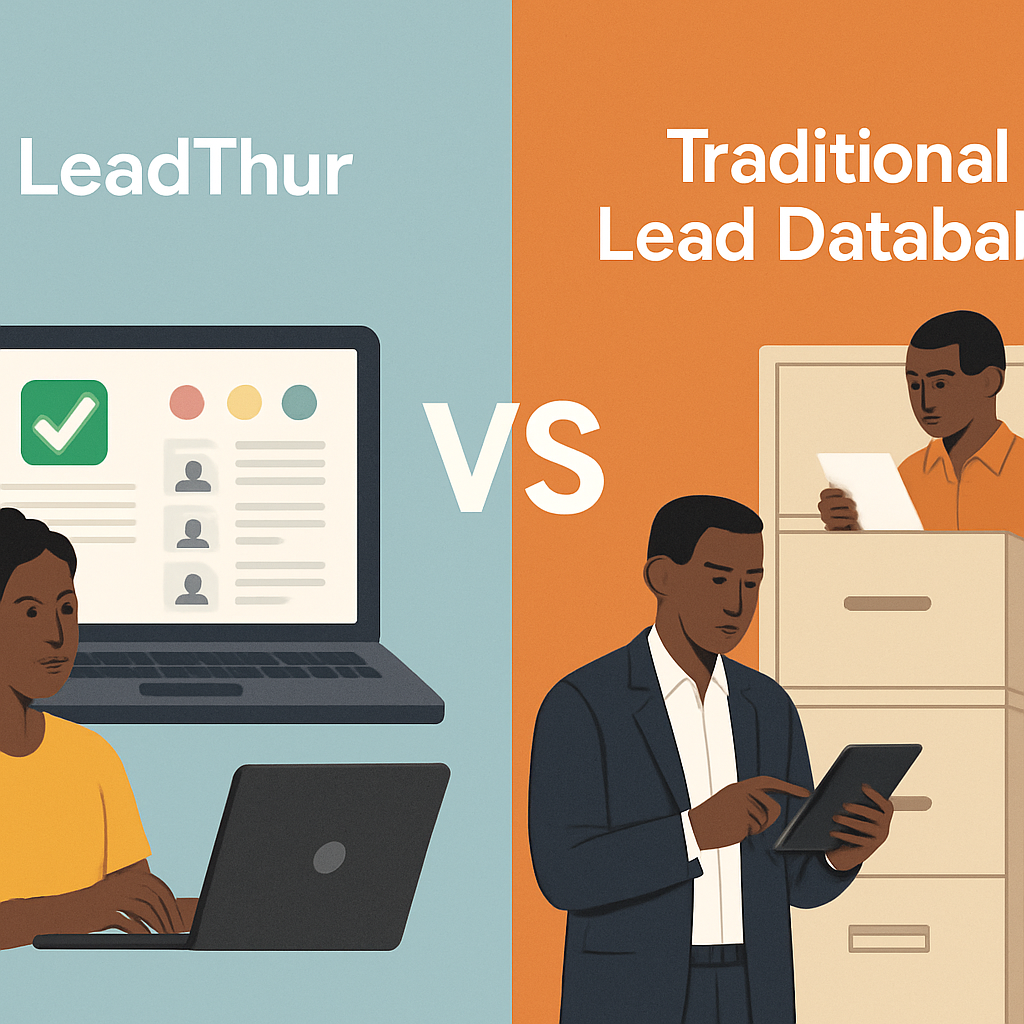
LeadThur vs. Traditional Lead Databases: What Actually Works for African Sales Teams
If you run a sales team in Lagos, Nairobi, Johannesburg, or Cairo, you have likely hit the same wall. You sign up for a global lead database—Apollo, ZoomInfo, Lusha, Cognism—because the marketing looks polished and the reviews are glowing. Then you search for businesses in your city, and the results are thin, outdated, or just plain wrong.
This is not a minor inconvenience. It is a structural failure. These tools were designed for Western markets where business data is abundant, standardized, and constantly refreshed. That environment does not exist in most of Africa. The result is that African sales teams pay Western prices for data that does not reflect their market reality.
LeadThur, built in Lagos, takes a different approach. It starts with local reality and builds outward. This article breaks down where traditional databases fail, what LeadThur does differently, and what you should actually look for when choosing a lead generation tool for your team.
The Core Problem: Data Built for San Francisco, Not Surulere
Global lead databases operate on a simple premise: business information is publicly available, standardized, and can be scraped, verified, and sold at scale. In the United States or the United Kingdom, that premise mostly holds. Company registries are digitized. Business websites are common. Email formats are predictable.
In Africa, the data environment is different. Many small and medium businesses operate without a strong digital footprint. A thriving logistics company in Ikeja might have a Facebook page and a phone number, but no website and no listed email. A construction firm in Nairobi might register under a slightly different name than the one it trades under. A supplier in Cairo might rely on word-of-mouth referrals rather than any online directory.
Global systems fail in Africa because the environment they were built for doesn't exist there. They scrape what they can, but the gaps are enormous. When you search for "manufacturers in Lagos," you get a handful of results, many with outdated contact information. Your sales rep spends an hour verifying numbers that do not connect.
The data gap is not just about missing records. It is about the type of data collected. Western databases prioritize email addresses because email outreach dominates B2B sales there. In Africa, phone calls and WhatsApp messages often convert better. A database that gives you 500 emails but no phone numbers is not actually useful for your team.
What Traditional Databases Charge—and What You Get
Let's talk about pricing, because this is where the pain becomes concrete. Apollo, ZoomInfo, Cognism, and Lusha are established, well-funded, and widely used. They are also priced for Western budgets.
A typical subscription for a small team runs anywhere from $49 to $150 per user, per month. ZoomInfo, at the enterprise end, can cost thousands per year. For a five-person sales team in Lagos, that is a significant recurring expense—often $3,000 to $9,000 annually—before you factor in the cost of outreach tools, email verification services, and the hours your team spends cleaning bad data.
Here is what that subscription actually delivers for an African sales team:
- A search interface built around Western business categories (SIC codes, NAICS classifications) that map poorly to African business structures
- Email addresses that bounce at high rates because the data was scraped years ago and never refreshed
- Phone numbers that are either missing or formatted for international dialing in ways that confuse local reps
- Limited coverage for smaller cities and towns outside major metros
- A monthly bill that keeps growing regardless of whether you found any usable leads
The pricing model itself is part of the problem. Monthly subscriptions assume a steady, ongoing need. But lead generation is not a constant activity for most African sales teams. You build a pipeline, work it, and then build again. Paying every month for a tool you use intensively for two weeks is wasteful.
Africa Is Not One Market—and Your Tool Must Respect That
One of the most common mistakes sales managers make is treating "Africa" as a single entity. It is not. Buyer behavior differs significantly across countries. A manufacturing company in South Africa operates within a formal, well-regulated economy with strong corporate governance. A trading business in Nigeria navigates a more informal, relationship-driven environment. An exporter in Egypt deals with different regulatory frameworks and payment systems entirely.
A lead database that treats all African businesses the same way is not just unhelpful—it is actively misleading. You need data that reflects local nuances: the right language for outreach, the correct business registration formats, the payment preferences that matter in each market.
LeadThur's approach is local-first. Built in Lagos, it understands that a business in Yaba operates differently from one in Sandton. The search system is designed to return relevant, usable contacts for specific cities and niches, not just broad national results. When you search for "boutique hotels in Accra," you get businesses that actually exist and operate in Accra, not a generic list of Ghanaian companies scraped from a global directory.
What LeadThur Actually Does Differently
LeadThur is not trying to be another global database with a few African entries bolted on. It was built from the ground up for how African sales teams work. Here are the specific differences that matter:
Local-First Data Collection
Instead of relying on Western data aggregators, LeadThur builds its contact lists from local sources: business registries, trade directories, local listings, and on-the-ground verification. This means the data reflects how businesses actually present themselves in each market, not how a Silicon Valley engineer assumes they should be categorized.
One-Time Pricing Instead of Monthly Subscriptions
Rather than charging a recurring fee, LeadThur uses a one-time payment model. You pay once, get access to the contacts you need, and own that data. There is no ongoing subscription draining your budget month after month. For a small agency or a growing sales team, this is a different financial commitment. You are not locked into a tool you barely use; you are buying a specific outcome—a list of qualified prospects.
Speed That Matches How You Actually Work
LeadThur takes about 60 seconds to deliver first results. You do not need to spend an afternoon learning a complex interface or configuring filters. You type a query, pick a location, and get a list. The average freelancer spends hours every week just finding businesses to pitch. That is time that could be spent actually pitching, following up, and closing. LeadThur compresses the prospecting phase from hours to minutes.
According to the LeadThur website, the platform provides over 1,000 contacts per search in any city across 195 countries. That scale is useful, but the real value is the relevance. A thousand contacts for "IT services in Nairobi" is only helpful if those contacts are current and accurate.
A Built-In Email Sender
Most lead databases give you a list of emails and then expect you to export them into a separate outreach tool. That creates friction: you have to clean the list, upload it, set up templates, and manage deliverability. LeadThur includes a built-in email sender, so you can move from search to outreach in the same workflow. This is not a revolutionary feature on its own, but it removes a step that wastes time for small teams without dedicated sales operations staff.
The Real Cost Comparison: Subscription vs. One-Time
Let's put the numbers side by side. Assume you have a three-person sales team in Lagos. With a traditional database like Apollo, you are looking at roughly $49 to $99 per user per month. That is $147 to $297 monthly, or $1,764 to $3,564 annually. You pay that every year, indefinitely, for access to a database that may or may not have good coverage for your market.
With LeadThur, you pay once for the contacts you need. You can do two free searches before you decide. If the data is not what you need, you have not lost anything. If it is, you pay a one-time fee, extract your list, and move on. There is no recurring cost, no renewal reminder, no guilt about paying for a tool you did not use this month.
For a business owner in Nigeria or Kenya, where cash flow is often unpredictable, this model is more sustainable. You are not committing to an ongoing expense. You are buying a specific, time-bound outcome. This is not just a pricing difference; it is a different philosophy about what a lead generation tool should be.
What to Look for in a Lead Generation Tool for African Teams
Regardless of whether you choose LeadThur or another tool, here are the criteria that matter for African sales teams:
| Criterion | Why It Matters | What to Ask |
|---|---|---|
| Local data coverage | Global databases often have thin or outdated records for African cities | How many contacts does it return for my specific city, not just my country? |
| Contact accuracy | Bounced emails and dead phone numbers waste your team's time | How recently was the data verified? What is the bounce rate? |
| Pricing model | Monthly subscriptions drain budgets even when unused | Can I pay once for a specific list, or am I locked into a recurring plan? |
| Speed of setup | Your team should spend time selling, not learning software | How long from signup to first usable lead list? |
| Outreach integration | Exporting lists to separate tools adds friction | Can I send emails directly from the platform? |
| Local business categories | Western classification systems miss how African businesses describe themselves | Can I search using local terms and business types? |
If a tool cannot answer these questions clearly, it is probably not built for your market. The fact that a platform has millions of users globally does not mean it has useful data for your city.
Why Manual Prospecting Is Not the Answer Either
Some sales managers respond to poor database quality by going back to manual prospecting. They tell their team to search Google, check directories, ask for referrals, and build lists by hand. This is understandable, but it is not scalable.
Manual prospecting also has a quality problem. When you search Google for "manufacturers in Lagos," you get a mix of outdated websites, directories that require registration, and businesses that have closed. Your team ends up calling dead numbers and sending emails to inactive addresses. The time spent is real, but the output is often no better than what a mediocre database provides.
The solution is not to abandon tools entirely. It is to use a tool that actually works for your context. That means local data, fair pricing, and a workflow that matches how your team operates.
What LeadThur's Free Searches Tell You
One of the most practical things about LeadThur is that it offers two free searches before you decide. This is not a marketing gimmick; it is a genuine opportunity to evaluate data quality without financial risk.
Here is how to use those free searches effectively. First, search for a niche you know well. If you sell accounting services, search for "accounting firms in Nairobi." Look at the results. Are they businesses you recognize? Are the contact details plausible? Second, search for a broader category in a city you are less familiar with. This tests the depth of coverage. If the tool returns hundreds of relevant contacts for a secondary city, it likely has strong data. If it returns a handful of obviously scraped entries, you know its limits.
This transparency is rare in the lead generation space. Most tools require a credit card before you see any meaningful results. LeadThur's willingness to let you test before paying suggests confidence in its data.
How LeadThur Compares to Apollo and Other Global Tools
It would be dishonest to claim LeadThur is universally "better" than Apollo or ZoomInfo. Those tools have strengths: massive data volumes, sophisticated filtering, integrations with major CRMs, and established support infrastructure. For a multinational company selling to Fortune 500 firms, they may be the right choice.
But for African sales teams, the comparison is not about raw features. It is about fit. Apollo's dominance in grid reports reflects its performance in Western markets. The question is whether that performance translates to Lagos, Nairobi, or Accra. For many teams, the answer is no.
Consider the specific pain points:
- Data accuracy: Global tools often have stale or incorrect records for African businesses. LeadThur's local-first approach prioritizes accuracy over volume.
- Pricing: Monthly subscriptions are expensive and recurring. LeadThur's one-time payment is more predictable and affordable for SMBs.
- Workflow: Global tools assume a complex sales stack with separate outreach, verification, and CRM systems. LeadThur's built-in email sender simplifies the process for smaller teams.
- Relevance: Global categories do not match African business realities. LeadThur's search is designed around how local businesses actually describe themselves.
The Cultural Dimension: Relationships Over Databases
There is a cultural mismatch that goes beyond data quality. Western lead generation assumes a transactional approach: find a contact, send an email, book a meeting, close a deal. This works in markets where cold outreach is normalized and decision-makers respond to unsolicited emails.
In many African markets, business is relationship-driven. A cold email from an unknown sender is likely to be ignored. A phone call or a WhatsApp message from someone who has been referred, or who has taken time to understand the business, has a much higher chance of getting a response. The best lead generation tools for African teams recognize this reality. They provide the contact information, but the outreach strategy must be adapted to local norms.
This is not a flaw in the tools; it is a feature of the market. The best approach is to use a tool like LeadThur to identify prospects, then invest time in building relationships through the channels that actually work in your market. A list of 1,000 contacts is only valuable if you know how to convert them into conversations.
Practical Steps to Evaluate LeadThur for Your Team
If you are considering LeadThur, here is a practical evaluation plan:
- Use your two free searches wisely. Test a niche you know and a broad category in a secondary city. Assess the relevance and accuracy of the results.
- Compare the cost. Calculate what you currently spend on lead generation tools annually. Compare that to LeadThur's one-time pricing for the same volume of contacts.
- Test the email sender. Send a small batch of emails from the platform. Monitor open rates and replies. If the deliverability is poor, the tool is not saving you time.
- Involve your sales team. Ask your reps to evaluate the data quality. They are the ones making the calls and sending the emails. Their feedback matters more than any feature comparison.
- Time your workflow. Measure how long it takes from search to first email sent. Compare that to your current process. The difference will tell you whether the tool is worth adopting.
This process takes less than a day. It gives you concrete evidence about whether LeadThur works for your specific market and team. If it does not, you have lost a few hours. If it does, you have found a tool that could save your team dozens of hours every week.
Frequently Asked Questions
Why do traditional lead databases fail to deliver accurate data for African markets?
They are built on Western data infrastructure—standardized registries, widespread business websites, and predictable email formats—that does not exist in most African markets. The data they scrape is often incomplete, outdated, or irrelevant to how African businesses operate.
What is the actual cost difference between LeadThur and subscription-based databases?
Subscription databases typically charge $49 to $150 per user per month, which adds up to thousands of dollars annually for a small team. LeadThur uses a one-time payment model, so you pay once for the contacts you need and own them. There is no recurring cost.
How much time can African sales teams save by using LeadThur instead of manual prospecting?
Manual prospecting can consume hours every week just finding businesses to pitch. LeadThur delivers results in about 60 seconds. For a team of five, that is potentially dozens of hours per week redirected from prospecting to actual selling.
What specific features should African sales teams look for in a lead generation tool?
Local data coverage for your specific city, accurate and recently verified contact details, a pricing model that does not require a recurring subscription, fast setup time, and an integrated outreach option. The tool should understand local business categories and communication preferences.
Can LeadThur's data quality match what global databases offer for African businesses?
For African markets, LeadThur's local-first approach often provides more relevant and accurate data than global databases, which have thin coverage. The two free searches let you evaluate data quality before committing.
How does the built-in email sender compare to using separate outreach tools?
The built-in sender eliminates the friction of exporting lists, cleaning data, and uploading to a separate platform. It is not as feature-rich as dedicated outreach tools, but for small teams it simplifies the workflow significantly. You can always export and use a more advanced tool later if needed.
Is a one-time payment model more sustainable for African SMBs than monthly subscriptions?
Generally, yes. Monthly subscriptions create ongoing costs that are hard to predict and often go underutilized. A one-time payment aligns cost with a specific outcome—a list of qualified prospects—which is easier to budget for and more aligned with how SMBs manage cash flow.
Sources
- LeadThur — Find 1,000+ Business Contacts in Any City in 60 Seconds
- About LeadThur — Built in Lagos. Used Worldwide.
- Africa Lead Generation Strategies Don't Work Globally
- B2B Lead Generation Tools South Africa: Picks That Win 2026
- If you are a freelancer or agency owner in Nigeria...
If you are ready to test whether LeadThur works for your market, start a search and see what comes back. The first two searches are free, and the results will tell you more than any review ever could.