How to Build a Sustainable Freelance Client Pipeline Using LeadThur (Nigeria & Africa Guide)
You land a big project in March. You celebrate. Then April comes and your inbox goes silent. You panic, scramble through old contacts, and send desperate cold emails to anyone with a business email address. By May, you land something small. The cycle repeats.
This is the feast-or-famine trap. It is not a personal failure—it is a systems failure. You don't have a pipeline. You have a hope that the next project will show up before the last one finishes.
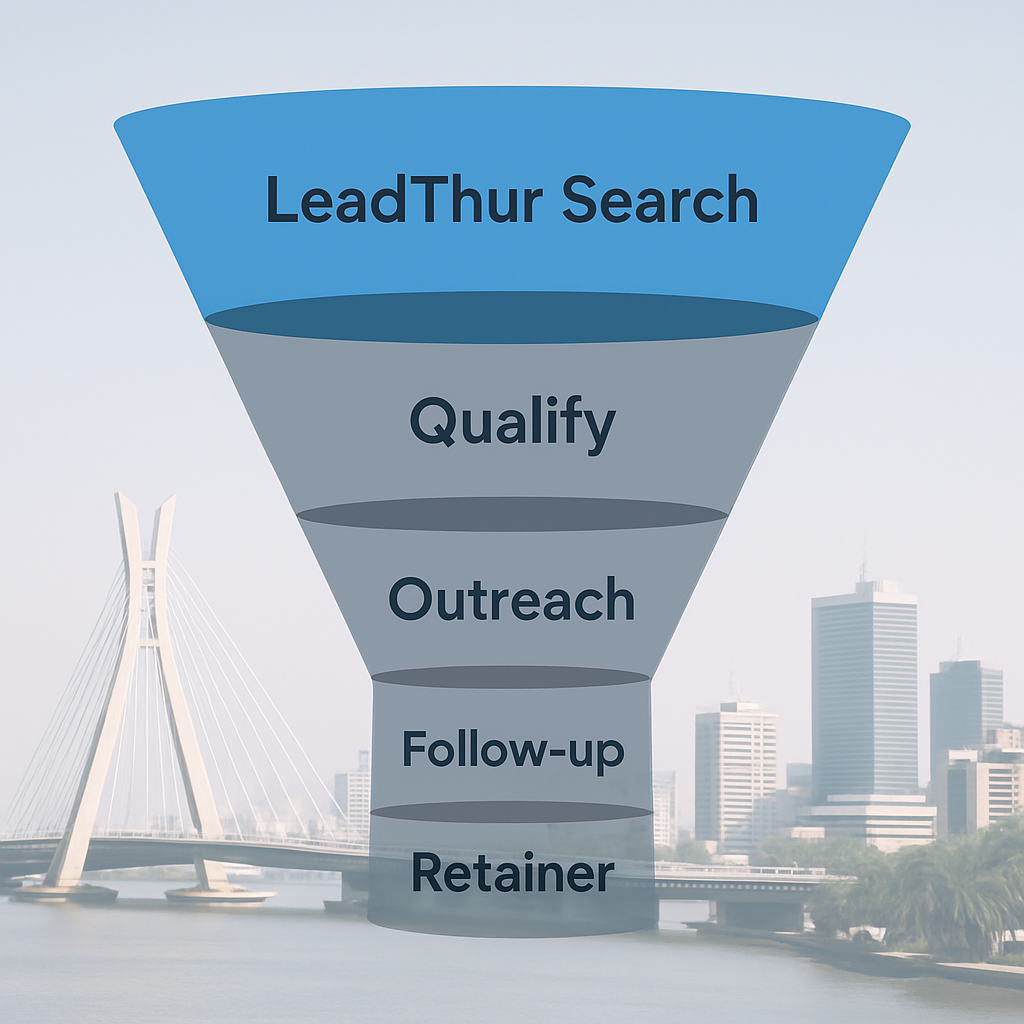
The fix is not to work harder. It's to build a repeatable process that consistently fills your client roster. This guide walks you through exactly that, using LeadThur—a business contact discovery platform built in Lagos—to remove the most painful part of freelancing: finding businesses to pitch.
Why Most Freelancers Fail at Client Acquisition
Most freelancers don't fail because their work is bad. They fail because their client acquisition is reactive. They wait until they need money before they start looking for work. That's like waiting until you're thirsty to dig a well.
Here's what the average freelancer's week looks like:
- 3–5 hours spent just searching for businesses to pitch (source: LeadThur About page)
- Browsing Google, LinkedIn, and social media for potential clients
- Copying contact details into spreadsheets manually
- Sending generic pitches to businesses that don't even need your service
The result? Low response rates, wasted hours, and a pipeline that looks like a desert. The problem isn't effort. It's that you're spending time on prospecting instead of pitching.
Here's the shift: stop looking for "any client" and start building a targeted list of businesses that fit your ideal profile. Then pitch them systematically. Then follow up. Then measure what works.
That's a pipeline. And it's not complicated. It just requires a process.
Step 1: Define Your Ideal Client Profile (ICP) for the Nigerian/African Market
You can't build a pipeline if you don't know who you're looking for. "Anyone who needs a website" is not a target. It's a wish.
An Ideal Client Profile (ICP) is a description of the business you want to work with. It answers five questions:
- Industry: What sector do they operate in? (e.g., logistics, fintech, retail, real estate, education)
- Location: Which city or region? (e.g., Lagos, Abuja, Nairobi, Accra)
- Size: How many employees? What's their likely revenue range?
- Pain point: What problem do they have that you can solve?
- Budget: Can they afford your rates? (A micro-business in Yaba may not pay the same as a Series A startup in Victoria Island.)
For the Nigerian and African market, be specific about location. A business in Lagos has different needs and budgets than one in Kano or Enugu. Similarly, a Nairobi-based e-commerce store has different logistics challenges than a Lagos one.
Here's an example ICP for a freelance web developer in Lagos:
Industry: Professional services (law firms, accounting firms, consulting)
Location: Lagos Island, Victoria Island, Ikoyi, Lekki Phase 1
Size: 5–50 employees
Pain point: Outdated websites that don't generate leads; poor mobile experience
Budget: Willing to pay ₦500,000–₦2,000,000 for a website redesign
Write down your ICP before you open any tool. It will save you hours of chasing the wrong businesses.
Step 2: Use LeadThur to Build a Targeted Prospect List in Minutes
Once your ICP is clear, the next step is finding businesses that match it. This is where most freelancers lose hours. They Google "law firms in Lagos," click through websites, hunt for contact pages, and copy emails into a spreadsheet. One business at a time. Painfully slow.
LeadThur solves this. You type any business type and city, and you get a full list of contacts instantly. No scraping, no manual copying, no outdated directories.
Here's how to use it for your pipeline:
- Open LeadThur and enter your target business type (e.g., "law firm") and city (e.g., "Lagos").
- Review the list of businesses that appear. You'll get names, contact details, and locations.
- Export or save the list to your CRM or spreadsheet.
- Repeat with variations: "accounting firm Lagos," "consulting firm Abuja," "real estate agency Accra."
In 30 minutes, you can build a list of 100+ qualified prospects. That's the difference between a system and a scramble. For a deeper dive into building lead lists specifically for Nigerian SMEs, check out our guide on building a high-quality lead list for Nigerian SMEs.
One note: don't try to pitch everyone on the list at once. Split it into batches of 20–30. This lets you personalize each batch and track which messages perform best.
Step 3: Qualify Leads: Separating Ready-to-Go from On-the-Fence
Not every business on your list is ready to buy. Some are in active pain. Others are mildly curious. A few are tire-kickers who will never spend a naira.
Qualifying leads is about sorting them before you pitch, not after. This saves you from wasting your best outreach on businesses that won't convert.
Use a simple scoring system. Give each lead a score from 1 to 10 based on three signals:
| Signal | What to look for | Score |
|---|---|---|
| Visible need | Outdated website, no social presence, poor reviews mentioning service issues | 1–4 |
| Growth signals | Hiring posts, new office openings, recent funding announcements | 1–3 |
| Ability to pay | Established business (5+ years), professional services, corporate clientele | 1–3 |
Leads scoring 7 or above are your "A-list." Pitch them first. Leads scoring 4–6 are your "B-list." Nurture them with a lighter touch. Leads scoring below 4? Skip them or save them for a mass email blast later.
This qualification step is why you don't need a list of 500 leads. You need 50 good ones. Quality beats volume every time.
Step 4: Craft Outreach That Gets Replies (With Templates)
Your outreach message determines whether you get a reply or a delete. Most freelancers send messages that sound like this:
"Dear Sir/Madam, I am a professional web developer with 5 years of experience. I can help you build a website. Please let me know if you are interested."
This fails for one reason: it's about you, not them. The business owner doesn't care about your experience. They care about their problem.
Here's a better structure for outreach to African business owners:
- Reference something specific about their business (from your LeadThur research or their website).
- Name the problem you noticed.
- State the outcome you can deliver.
- Make a low-friction ask (a call, a quick reply, a sample).
Here's a template that works for a web developer pitching a Lagos law firm:
Subject: Your website is losing you clients
Hi [Name],
I came across [Firm Name] while researching law firms in Lagos. Your team's track record in [practice area] is impressive.
But I noticed your website takes 8+ seconds to load on mobile. In my experience, that's costing you potential clients—most people abandon a site that slow.
I build fast, mobile-optimized websites for law firms. A recent project for a similar firm in Ikoyi cut their load time by 70% and doubled their consultation requests.
Would you be open to a 15-minute call this week to discuss what I could do for [Firm Name]?
Best,
[Your Name]
Notice what this message does: it shows you did research, it names a specific problem, it offers proof, and it asks for a small commitment. That's how you get replies.
For more templates tailored to African business owners, read our post on 10 outreach email templates that actually get responses.
Step 5: Follow Up Like a Pro (Without Being Annoying)
Here's a hard truth: most sales happen after the fifth touch. Most freelancers give up after the second. That gap is your opportunity.
The average freelancer sends one email and waits. When they don't hear back, they assume the business isn't interested. But here's what's actually happening: the business owner is busy, your email got buried, or they're not ready yet.
Follow-up is where the pipeline gets built. Here's a simple sequence:
| Day | Action |
|---|---|
| Day 1 | Send initial outreach email |
| Day 3 | Send a brief follow-up: "Just bumping this to the top of your inbox. Any thoughts?" |
| Day 7 | Send a value-add: a relevant article, a quick tip, or a case study |
| Day 14 | Send a final email: "I'll close this out for now. If a need comes up, my door is open." |
The key is to add value in each follow-up, not just repeat yourself. Don't send "just checking in" emails. Send something useful.
One rule: never follow up more than four times. After that, you're not persistent—you're a nuisance. Move on to the next lead in your pipeline.
Step 6: Turn One-Off Projects into Retainers and Referrals
A pipeline isn't just about new clients. It's about keeping the clients you already have. One-off projects are fine, but they don't build a sustainable business. Retainers do.
Here's the math: if you land one new client per month at ₦500,000 per project, you're making ₦6,000,000 a year—but you're constantly hunting. If you convert just three of those clients into ₦300,000/month retainers, you have ₦900,000 in recurring revenue before you pitch anyone new.
How do you make that conversion? It starts during the project, not after.
- Deliver more than promised. Go the extra mile on the first project. It's easier to upsell a happy client than to convince a cold one.
- Identify recurring needs. A website isn't a one-time thing. It needs updates, security patches, content changes, performance optimization. Point these out to your client.
- Propose a retainer before the project ends. Don't wait until the final invoice. In your last week, say: "I've noticed your site will need monthly updates. I offer a maintenance retainer that covers this. Would you like me to set it up?"
- Ask for referrals. Referred customers have a 37% higher retention rate than clients acquired through other channels (source: Client Acquisition Strategies for Freelancers). Ask every happy client: "Do you know another business that could use my help?"
Following up after a project can lead to repeat business and referrals. It's the cheapest marketing you'll ever do.
Step 7: Measure and Refine Your Pipeline Weekly
A pipeline is a system, and systems need measurement. If you don't track your numbers, you can't improve them.
Set aside 30 minutes every Friday to review your pipeline. Track these metrics:
- Leads added: How many new prospects did you add this week?
- Outreach sent: How many emails did you send?
- Replies received: How many people responded?
- Calls booked: How many conversations did you schedule?
- Proposals sent: How many formal quotes did you send?
- Projects won: How many deals closed?
Once you have a few weeks of data, you'll see your conversion rates. If you send 100 emails and get 5 replies, your reply rate is 5%. If you get 5 replies and book 2 calls, your call booking rate is 40%.
Then you can improve. If your reply rate is low, rewrite your subject lines. If your call booking rate is low, improve your pitch. If your close rate is low, check your pricing or qualification process.
This weekly review is what separates freelancers who build sustainable businesses from those who stay stuck in feast-or-famine.
Common Mistakes to Avoid (and How LeadThur Helps)
Even with a system, freelancers make mistakes. Here are the most common ones—and how to avoid them.
Mistake 1: Pitching to the wrong businesses
If you pitch a business that doesn't need your service, no amount of great copy will save you. LeadThur helps you target specific business types and cities, so you're always pitching to businesses that fit your ICP. For more on this, read our guide on sales prospecting mistakes that kill your close rate.
Mistake 2: Using outdated contact information
Nothing kills a pitch faster than an email that bounces. LeadThur provides current business contact details, so you're not wasting time on dead addresses.
Mistake 3: Sending generic, copy-paste messages
Business owners can smell a mass email from a mile away. Use the specific information LeadThur gives you to personalize each message. Reference their location, their industry, or something you noticed about their business.
Mistake 4: Giving up too early
Most freelancers stop after one follow-up. The data says you need more touches. Commit to a four-touch sequence before you give up on a lead.
Mistake 5: Not tracking anything
If you don't know your numbers, you're guessing. Track your pipeline weekly and make data-driven decisions.
Frequently Asked Questions
How do I find the right businesses to pitch as a freelancer in Nigeria?
Start with your ICP. Define the industry, location, and size of business you want to work with. Then use LeadThur to search for specific business types in specific cities. For example, if you're a copywriter targeting real estate companies, search "real estate agency Lagos" and "real estate agency Abuja." You'll get a list of businesses to pitch in minutes.
How can I build a prospect list without wasting hours on Google?
Stop searching manually. LeadThur lets you type any business type and city to get a full list of contacts instantly. This turns a 3–5 hour weekly task into a 30-minute one. For a more detailed approach, see our step-by-step guide on building a high-quality lead list for Nigerian SMEs.
What's the best way to qualify leads so I don't waste time on tire-kickers?
Use a scoring system. Look for visible need (outdated website, poor online presence), growth signals (hiring, expansion), and ability to pay (established business, professional services). Score each lead from 1–10 and pitch your highest scorers first.
How do I write outreach messages that get responses from African business owners?
Reference something specific about their business, name a problem they likely have, state the outcome you can deliver, and make a low-friction ask. Avoid generic "I can help you" messages. Personalization is the key to getting replies. See our outreach email templates for ready-to-use examples.
How do I turn a one-off project into a recurring retainer?
Identify recurring needs during the project (updates, maintenance, content, optimization). Propose a retainer before the project ends, not after. Frame it as a solution to a problem they'll have, not as a way for you to make more money.
Your Next 30 Days to a Sustainable Pipeline
Building a pipeline doesn't happen overnight. But it can happen in 30 days if you commit to the process. Here's your plan:
Week 1: Define your ICP. Write it down. Be specific about industry, location, and pain points.
Week 2: Use LeadThur to build a list of 50–100 prospects that match your ICP. Score them and pick your top 20.
Week 3: Send personalized outreach to your top 20. Follow up with anyone who doesn't reply after 3 days.
Week 4: Book calls, send proposals, and close deals. Review your numbers. What worked? What didn't? Adjust and repeat.
If you're just starting out and want a faster approach, read our guide on building a client pipeline from scratch in one day. It's a quick-start version of this process.
And if you're comparing tools, check out our analysis of the best Apollo.io alternatives for freelancers to see where LeadThur fits.
The feast-or-famine cycle ends when you stop relying on luck and start relying on a system. LeadThur gives you the raw material—the contacts. The rest is up to you.
Start with a free trial search. Try LeadThur and see how fast you can build a list of businesses to pitch. Your pipeline won't build itself, but it will build a lot faster with the right tools.
Sources
- About LeadThur — Built in Lagos. Used Worldwide.
- How to Make Freelance Clients Come to You
- Client Acquisition Strategies for Freelancers
- Client Acquisition: Tips to Acquire Clients & Set Up Your Strategy
- The Realistic Way To Build A Sustainable Freelance Business Online
- Strategies to Find Clients as a Freelancer (Without Waiting for Them to Find You)
- All the different strategies I use to grow a sales pipeline as a freelancer
- Building a Stable Client Pipeline for Freelancers